Mindme.


2024
Personal Project
Product Designer | 2024 | Mental Health Platform
This was one of my first design projects and the execution reflects that — it's not my strongest visual work and I know that. But the problem behind it is one I genuinely care about and keep returning to. I'm including it because the thinking matters, even when the design is still catching up.
The Problem
Your therapist only knows what you remember to tell them. In a 50-minute session, that's rarely the full picture — patients forget 40-80% of medical information immediately after an appointment. Meanwhile, the average person managing their mental health juggles 3-4 separate apps — mood here, sleep there, meditation somewhere else — none of which talk to each other, and none of which your therapist ever sees. 74% quit those apps within weeks.
Not because they stopped caring, but because the effort never felt connected to anything real.
How might we give therapists complete patient context while simplifying the patient experience into one platform?


My Process
Research & Discovery
Interviews with 4 people in therapy revealed something unexpected — the problem wasn't that people weren't trying. They were tracking their mood, logging their sleep, and meditating. They just had no way to make it mean anything. Competitive analysis of Calm, Headspace, and Stoic confirmed why: every app existed in isolation, with no connection to ongoing therapy or the clinicians responsible for their care.
Key insight: Fragmentation isn't just inconvenient — it's a barrier to healing
Design Decisions
Usability testing with 5 participants made one thing clear: users didn't want more features — they wanted their existing effort to mean something to their therapist. That shaped three decisions:
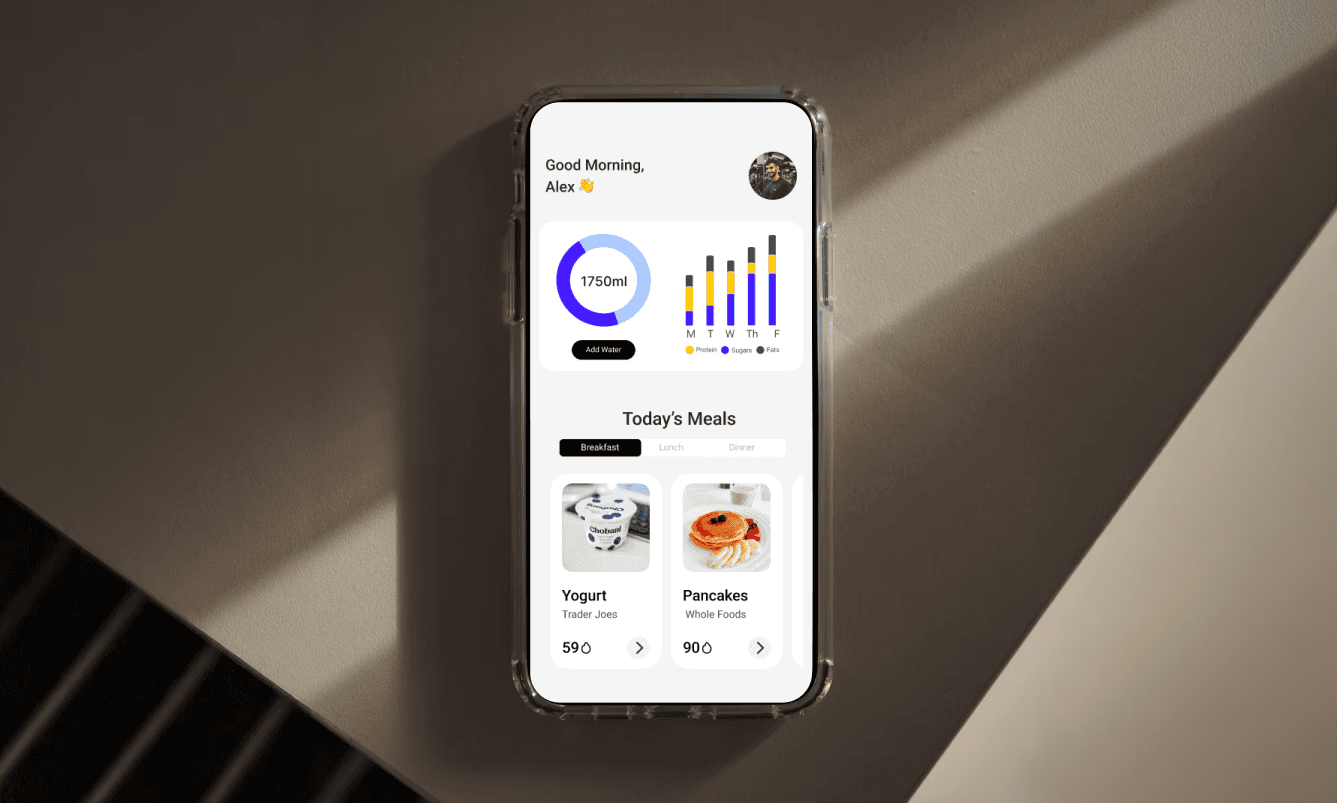
Complete Health Dashboard — mood, sleep, exercise, meals, and energy in one place. Therapists finally see the correlations patients struggle to articulate in 50 minutes.
Therapy Goals & Progress — therapist-set goals broken into daily actions with visual tracking. Sessions start with data, not catch-up.
Therapist Connection — shared health data with patient consent, secure messaging, and auto-generated progress summaries between sessions.
Results
8/10 | Simplicity score across key tasks |
5/5 | Users felt therapists would understand their full context |
Early-stage usability testing, 5 participants. Therapist-side testing planned for next round.
Design goals for future validation: 70%+ weekly active usage vs. 26% industry average · 60%+ goal completion with therapist visibility
Key Takeaways
Fragmentation is a design problem — consolidation is the intervention, not more features.
Clinician visibility changes the dynamic — when progress is shared, sessions shift from evaluative to collaborative.
Simplification requires trade-offs — every feature had to earn its place.
Reflection
This project was the beginning of my design journey. Looking back, there's a lot I'd do differently — but the problem space is one I keep returning to. Fragmented mental health care is a real, unsolved challenge and one I intend to revisit with everything I've learned since.